




According to the World Health Organization (WHO), cancer is the leading cause of death worldwide.
The Canadian Cancer Statistics, 2025 highlights that 2 in 5 Canadians are expected to develop cancer during their lifetime, and approximately 1 in 4 Canadians will pass away.
In 2025, an estimated 254,800 individuals will receive a cancer diagnosis, and 87,400 will pass away from this disease.
Source: Canadian Cancer Statistics 2025.
About this Cancer
There are various symptoms caused by cancer depending on which region of the body is affected.
General symptoms can include:
- Tiredness
- Unintentional weight loss/weight gain
- Changes to the skin, including yellowing, darkening or redness of the skin, persistent inflammation, or modifications to preexisting moles
- Difficulty breathing or recurring cough
- Recurring muscle/joint pain
- Recurring fevers/night sweats
- Unusual bleeding or bruising
- Differences in bowel or bladder habits
From: Mayo Clinic
The International Agency for Research on Cancer organizes agents within 4 categories depending on the level of certainty that the agent can cause cancer. The infographic below illustrates the 4 different categories.
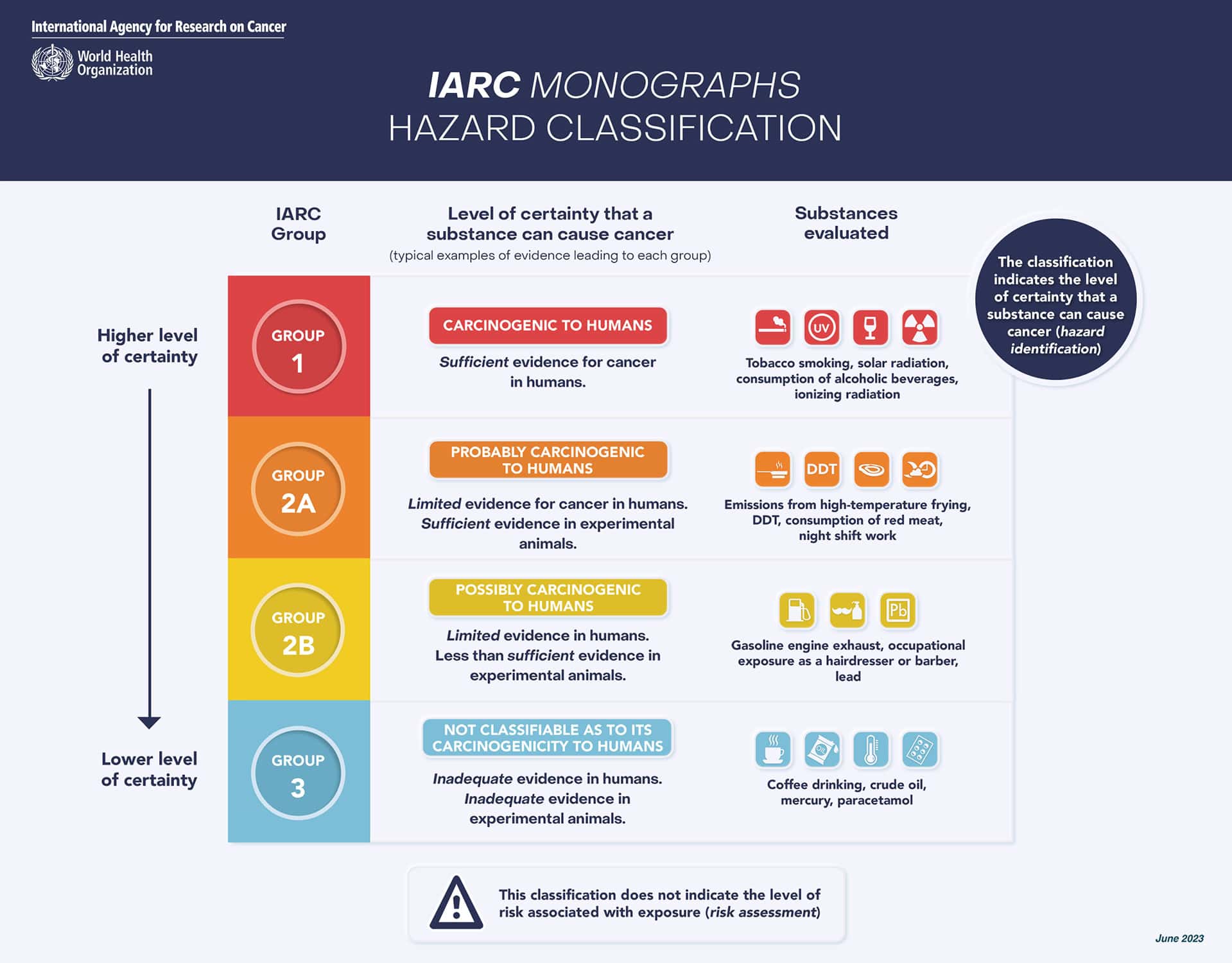
Source: https://www.iarc.who.int/infographics/iarc-monographs-classification/
The following may be used to diagnose cancer:
- Health history and physical examination
- CT scans, MRI, Ultrasound
- Biopsies
- Genetic testing
From: Cleveland Clinic
There are 3 primary options for cancer treatment: surgery, chemotherapy, and radiation. Alternative treatment options, including biological and hormonal therapies, might also be examined. Note that precise treatment plans will differ between patients and will depend on the type and stage of your cancer.
Resources
- Cancer Centres: Cancer Centres
- Financial Toolkit: Financial help – Canadian Cancer Survivor Network
- Mental health: Mental wellness
- Nutrition: Nutrition – Canadian Cancer Survivor Network
- Wabano Centre: Wabano serves members of Ottawa’s Indigenous community, from providing healthcare to mental health programs, cultural events and classes, and collaborating with social service providers.
- Champlain Indigenous Cancer Program: This program was created to help improve the ‘ care experience of Indigenous people diagnosed with cancer, and offers various services. Visit the linked program for more information.
- Indigenous Patient Resources: A host of resources, and toolkits for patients, and family members.
- Indigenous student researchers are shaping the future of cancer research
- September 19 2025 – The Impact of Artificial Intelligence on Cancer Diagnosis and Treatment: A Review – Sage Journals
- October 30 2025 – Artificial intelligence in cancer: applications, challenges, and future perspectives – PMC
- November 27 2022 – Incidence, factors, and disparities related to cancer among Black individuals in Canada: A scoping review – Wiley
- October 22 2024 – Initiatives to increase breast and cervical cancer–related knowledge, screening, and health behaviours among Black women – Springer Nature
- May 29 2025 – Tissue-agnostic cancer therapies: promise, reality, and the path forward – Nature Communications
- April 29 2023 – Self-Employed Canadians’ Experiences with Cancer and Work: A Qualitative Study – MDPI
- January 17 2023 – The Impact of Patient-Centered Care on Cancer Patients’ QOC, Self-Efficacy, and Trust Towards Doctors: Analysis of a National Survey – PMC
- July 17 2024 Exploring treatment options in cancer: tumor treatment strategies | Signal Transduction and Targeted Therapy – Nature
- December 20 2024 – Personalized medicine: An alternative for cancer treatment – ScienceDirect
- July 16 2025 – Collecting Data on the Social Determinants of Health to Advance Health Equity in Cancer Care in Canada: Patient and Community Perspectives – MDPI
- August 15 2021 – “My Cancer Is Worth Only Fifteen Weeks”? A Critical Analysis of the Lived Experiences of Financial Toxicity and Cancer in Canada – PMC
- Feb 19 2025 – Improving Digital Cancer Care for Older Black Adults: Qualitative Study – JMIR
- August 20 2022 – The global burden of cancer attributable to risk factors, 2010–19: a systematic analysis for the Global Burden of Disease Study 2019 – The Lancet
- July 1 2025 – Therapeutic breakthroughs in oncology: Enhancing treatment and management – PMC
- April 27 2024 – Addressing social needs in oncology care: another research-to-practice gap | JNCI Cancer Spectrum – Oxford Academic
- First Nations, Inuit, Métis and Urban Indigenous Cancer Strategy (2024 to 2028) – Cancer Care Ontario
- May 15 2025 – Enhancing the Cancer Care Journey for Indigenous Patients: A Guide for Oncology Nurses – PMC
- March 12 2026 – This Epigenetic Switch Could Be Targeted by New Cancer Therapies – Rockefeller University
- February 17 2026 – OncoPro: Transforming Cancer Care Through Real-Time Symptom Monitoring – Sylvester Comprehensive Cancer Center
- January 27 2026 – Mount Sinai Study Finds Antibody-Producing Immune Cells Can Help Shape Cancer Immunotherapy – Mount Sinai Health System
- February 2 2026 – Detecting Early-Stage Cancers with a New Blood Test Measuring Epigenetic Instability – John Hopkins Medicine
- May 8 2026 – Extra Sets of Chromosomes May Help Aggressive Tumor Cells Spread, Study Finds – Tulane University
- May 6 2026 – Mount Sinai Study Identifies New Strategy to Overcome Immunotherapy Resistance in Colorectal Cancer – Mount Sinai Health System
The First Nations Principles of OCAP, an abbreviation for ownership, control, access, and possession, maintain that First Nations “have control over data collection processes, and that they own and control how this information can be used.” Below are studies that have incorporated OCAP principles into cancer research:
- Assessing colorectal cancer screening and outcomes among First Nations people in Alberta – PMC
- What culturally safe cancer care means to Algonquins of Pikwakanagan First Nation – Sage Journals
- Cervical and breast cancer screening outcomes among Métis people in Alberta, Canada | BMC Women’s Health | Springer Nature Link
- Assessing Breast Cancer Screening and Outcomes Among First Nations Women in Alberta
- Colorectal Cancer Screening Among Métis and Non-Métis Males and Females in Alberta, Canada
- Cancer and the Environment projects with four First Nations organizations: working together to address concerns about carcinogens in the environment – PMC
- Cervical cancer screening outcomes among First Nations and non?First Nations women in Alberta, Canada – ScienceDirect
OCAP® is a registered trademark of the First Nations Information Governance Centre (FNIGC)
Click here to learn more.
All Cancer Groups
- Prevent Cancer Now: Their mission is to “Build a Canada-wide movement to eliminate preventable contributors to cancer through research, awareness, education and advocacy.”
- Best Medicines Coalition: Their mission is to “seek timely access to a comprehensive range of medically necessary, safe, and effective drugs and related treatments, informed by patient-driven evidence and values, and delivered equitably and affordably to all patients in Canada.”
- Canadian Cancer Society: Leading the way to a future without cancer“, the Canadian Cancer Society “funds groundbreaking cancer research; provides a national support system; advocates for healthy policies; and offers trusted cancer information.”
- Quebec Cancer Coalition – A Strong Voice for People Affected by Cancer: “The Quebec Cancer Coalition, a group of more than 70 non-profit organizations representing all types and phases of cancer from all regions of Quebec, aims to improve public health policy for and with people affected by cancer.”
- The Canadian Immunocompromised Advocacy Network: “We advocate for the health, safety and inclusion of immunocompromised people in Canada by offering trusted information, tools and collective action.”
- All.Can Canada: “All.Can Canada is a member of the international All.Can Group, a multi-stakeholder not-for-profit organisation working to improve the efficiency of cancer care by focusing on what matters to patients.”
- The Ottawa Cancer Foundation: Their mission is to “support people living with cancer, their caregivers and their families by providing the most effective community-based cancer care, resources, and programs. “
- Cancer System Navigator – Ottawa Cancer: Navigator services are “offered in English and French with access to over 150 languages through Ottawa Language Interpretation Services.”
- Cancer Action Now: “Cancer Action Now is a national alliance of patient organizations, professional associations, and life science companies who are witnessing the magnitude of the problem our cancer care systems and its patients are facing. We have come together to call on governments to address the issues in our cancer care systems so that Canadians with cancer have a chance to live longer, better lives than anywhere else in the world.”
- All.Can (Based in Belgium but operates internationally)
- International Cancer Foundation
- International Agency for Research on Cancer
- Union for International Cancer Control (UICC)
- European Organisation for Research and Treatment of Cancer