





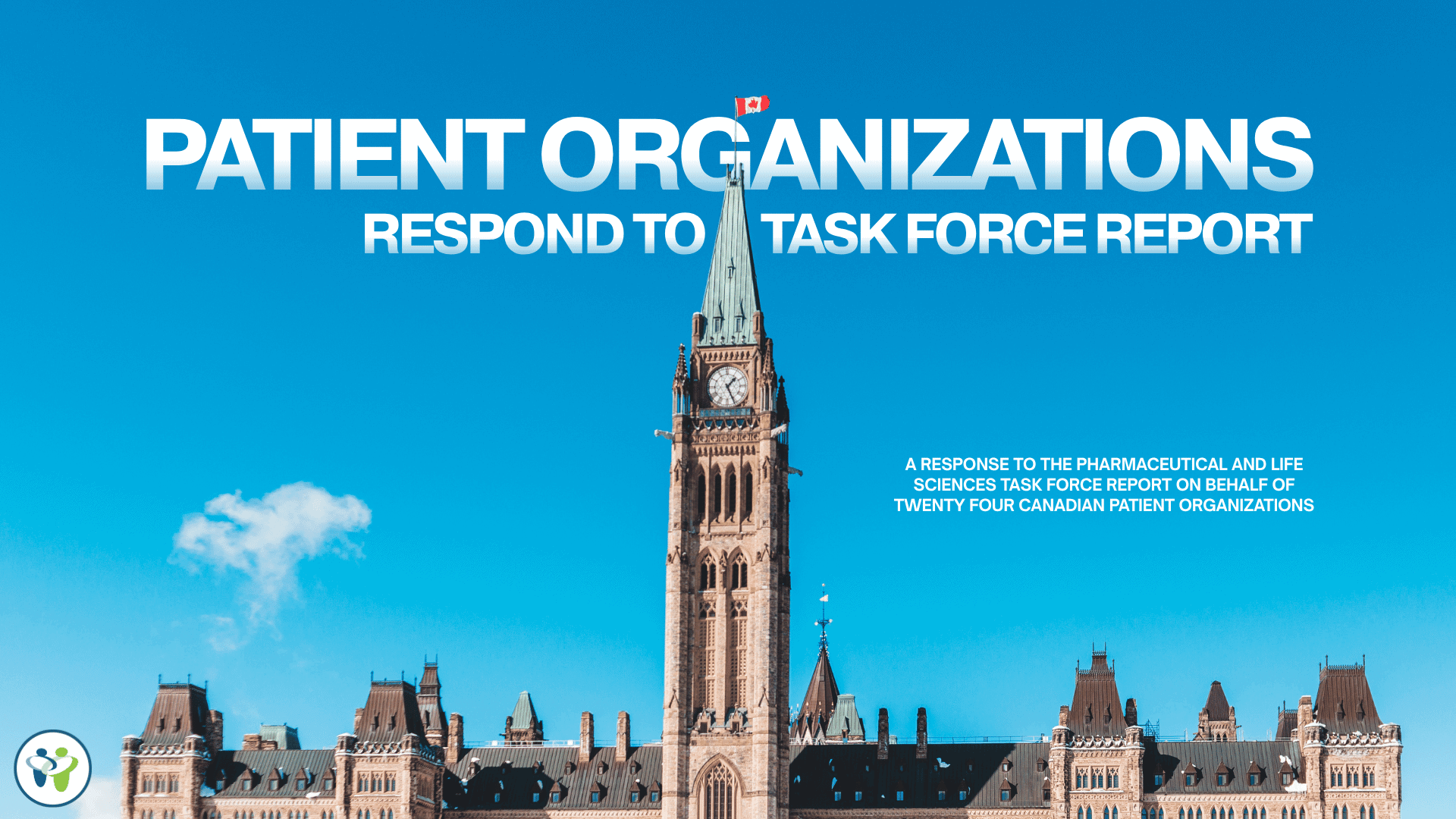
This letter was written in response to the report to ministers from the Pharmaceutical and Life Sciences Sector Task Force. For the full report, click HERE.
September 2026
The Honourable Marjorie Michel, P.C., M.P.
Minister of Health
The Honourable Mélanie Joly, P.C., M.P.
Minister of Industry
cc: Martin LeBlanc and Michelle Boudreau, Co-Chairs, Pharmaceutical and Life Sciences Sector Task Force
Response to the Report of the Pharmaceutical and Life Sciences Sector Task Force to the Ministers of
Health and Industry (July 24, 2026)
Dear Minister Michel and Minister Joly,
On behalf of the 24 national patient advocacy organizations that made a joint submission to the Pharmaceutical and Life Sciences Sector Task Force in June 2026, we write to welcome the publication of the Task Force’s report to you on July 24, 2026. The report is ambitious in scope and serious in intent. Thirty-nine recommendations spanning regulatory modernization, health technology assessment reform, pricing and reimbursement, clinical trials infrastructure, and national data architecture underscore a true commitment to ensuring that Canada remains competitive for life sciences and pharmaceutical innovation, and to protecting and improving access to life-changing treatment. We are partners who want to see this agenda succeed, and who want to ensure it succeeds for the people we represent. We write to you directly because the decisions that will determine whether this report changes patients' lives are decisions for government, and we want to be useful to you as you make them.
Our June 2026 submission asked for three things: that time to patient access be adopted as a formal system performance indicator, that a national dashboard be established to track and report on that indicator, and that patient organizations be recognized and resourced as implementation partners across the drug development and access pathway. Reading the report against that submission, we see meaningful movement on the first two asks. The value framework proposed in Recommendation 8 and the pCPA mandate review in Recommendation 10 point toward the kind of performance orientation we called for, and the data infrastructure proposals in Recommendations 18 and 19 lay real groundwork for the dashboard we envisioned. The third ask is the one that remains open, and it is the focus of most of what follows. It is also, in our view, the ask that needs to be prioritized during implementation: representation of lived experience in governance cannot be assumed into existence, and we hope to see it written into the mandates of the bodies that will carry this work forward.
We would also offer a broader frame for this work. A healthy society is a productive society. Timely and equitable access to best-in-class treatments is not only a matter of compassion or fairness; it is a precondition for a functioning economy. Canadians who can access the right treatment at the right time stay in their jobs, stay in school, care for their children and aging parents, volunteer in their communities, and remain contributors rather than becoming dependants on a system already under strain. Delay carries a cost that never appears on a drug budget: lost workdays, foregone earnings, caregivers stepping back from paid employment, avoidable hospitalizations, and disability claims that could have been prevented. Every month a Canadian waits for a treatment that is already available elsewhere is a month of productivity the country does not recover. Read this way, the health and industry agendas in this report are not competing priorities to be balanced against one another. They are the same agenda: a country that adopts innovation quickly is a country that is healthier, more productive, and more attractive to the investment the Task Force is seeking to secure.
That case is not theoretical, and it is why the urgency of this moment is difficult to overstate. In the past year alone, 48 medicines have had their Canadian launches cancelled or delayed — 16 launches
cancelled outright and 32 more delayed — according to a survey of 31 pharmaceutical and life sciences companies conducted by EY for Innovative Medicines Canada and reported in August 2026. Some of these treatments had already been approved by Health Canada. Behind that number are Canadians with cancer, rare disease, severe asthma, inflammatory conditions and immune disorders who will now wait longer than patients in peer countries for a therapy that exists, works, and is being launched elsewhere. Canada already has the longest wait times in the G7 for public access to new medicines, and only a fraction of the medicines launched globally ever reach our public drug plans. A market that is slow, fragmented and unpredictable eventually stops being a priority market at all — and it is patients, and the productivity of the workforce they belong to, who absorb that cost first. We raise this not to relitigate any single pricing or regulatory decision, but because it is the clearest available evidence that the reforms in this report are needed now rather than incrementally, and that speed of implementation is itself a patient outcome.
Improving System Performance and Ensuring Access to Innovative Treatments
The proposed redefinition of value in Recommendation 8 — to encompass clinical and patient value alongside health system value and societal value — is the single most consequential recommendation in the report from a patient perspective. For years, reimbursement decisions in Canada have been shaped by a narrow reading of clinical value that leaves little room for what matters most to the people living with a condition: functional status, symptom burden, caregiver impact, and quality of life. While there have been significant improvements in considering patient and caregiver input, a value framework that names patient value as a formal pillar, on equal footing with system and societal considerations, is the right foundation to build on.
We are similarly encouraged by the proposed review of the pCPA mandate in Recommendation 10. If patient and societal value are to be more than aspirational language in a framework document, they need to carry real weight in the negotiations that determine what patients can actually access and when. A mandate review that takes this seriously has the potential to close the gap between what the value framework promises and what patients experience at the pharmacy counter.
The national health data infrastructure and real-world evidence proposals in Recommendations 18 and 19 address a longstanding and well-documented weakness in the Canadian system. The inability to track a medicine's journey from approval to patient access, consistently and transparently, has made it difficult to hold any part of the system accountable for delay. A pan-Canadian data architecture, built well, is the infrastructure on which a genuine time-to-access dashboard depends, and we are glad to see it treated as a priority rather than an afterthought. With access to real-world data on access, we are able to work collaboratively with federal, provincial and private insurers to close these gaps. Collectively with industry, patient partners and regulators, we can ensure that processes are streamlined to remove duplication, elevate Canada’s status as an efficient priority market, and ensure Canadians get timely access to the treatments they need — and get back to work, and to their families, sooner.
We also welcome the clinical trials proposals in Recommendations 13 through 16. Our patients frequently navigate provincial health programs to qualify for out of province clinical trials. This adds undue burden to families already navigating health conditions. Harmonized trial approval and stronger national infrastructure matter to patients not only as future beneficiaries of research but as active contributors to it. Patient organizations play a recognized role in trial recruitment, retention, and in ensuring that trial populations reflect the diversity of the people who will ultimately use these therapies. Canada’s diverse population offers global industry partners the opportunity to capture rich and diverse research data and we see this as an area where our members are well positioned to support the Task Force’s ambitions in practice, not just in principle.
Strengthening Patient Partnership in Implementation
The primary goal of our submission is to help implement these ambitious and needed reforms, and we believe that patient partners will be critical to the success of Recommendation 39. The report proposes four implementation teams and an overarching body to translate these thirty-nine recommendations into policy. We recognize that how that architecture is finally designed, mandated and resourced is a decision for you and your officials rather than for the Task Force, and we offer the following five suggestions in that spirit. First, we would encourage you to name patient organizations as members of the implementation teams and of the overarching body — as partners at the table rather than external stakeholders consulted after the fact. A formal seat, rather than an occasional briefing, is the single change most likely to keep this agenda anchored to the outcomes that matter to Canadians.
Second, Recommendation 5 proposes a technical working group that includes industry representatives but makes no mention of patient representation. Given that this group would shape the technical detail beneath the broader recommendations, its composition will matter as much as its mandate. We would encourage you to include patient representation in this group on the same terms as industry participation.
Third, Recommendation 8’s value framework identifies clinical and patient value as a pillar but does not yet specify how patient-generated evidence — including patient-reported outcomes, patient-reported experience measures, and lived experience testimony — would be collected, weighted, or resourced within it. Without that specificity, there is a real risk that patient value remains a heading on a page rather than a functioning input into decisions. As the framework moves from recommendation to design, we would ask that patient-generated evidence be named as a defined data category with a clear collection and resourcing pathway. Patient groups already support real-world evidence generation through their work with patients, survivors and caregivers, and are ready to contribute to that pathway.
Fourth, Recommendation 9 proposes a single-window navigator function within CDA-AMC to help sponsors move through the assessment pathway. Patient organizations navigate that same pathway, often with far fewer resources than sponsors, and currently have no equivalent point of contact. We would ask that a parallel navigation function be established for patient organizations within CDA-AMC, scaled appropriately to our capacity but equal in principle to the sponsor-facing function.
Fifth, the data infrastructure work contemplated in Recommendations 18 and 19 should treat patient-reported outcome data as a core component of the pan-Canadian data architecture, not an adjunct to administrative health data. A dashboard built solely on administrative timestamps will tell us when a decision was made; it will not tell us what that decision meant for the person waiting. Both are necessary, and only the second tells you whether the investment is producing healthier, more productive Canadians.
We offer these observations to add specificity and ensure inclusion within the direction the Task Force has set, not to revisit or reopen the report’s architecture.
The 24 organizations named in our submission are ready to serve as implementation partners in the work ahead. We would welcome the opportunity to meet with you, your officials, or the overarching implementation body once constituted, to discuss how patient partnership can be built into this next phase from the outset — and how a healthier, faster-adopting Canada can also be a more productive one. Please direct any response or scheduling request to Lindsay Timm at ltimm@survivornet.ca or Riley Sanders at rsanders@gaapp.org.
Sincerely,
Lindsay Timm
Executive Director, Canadian Cancer Survivor Network
Riley Sanders
Head of Government Relations and Public Affairs, Global Airways and Allergies Patient Platform
On behalf of:
[Patient Group Signatories — as per June 4, 2026 submission]