






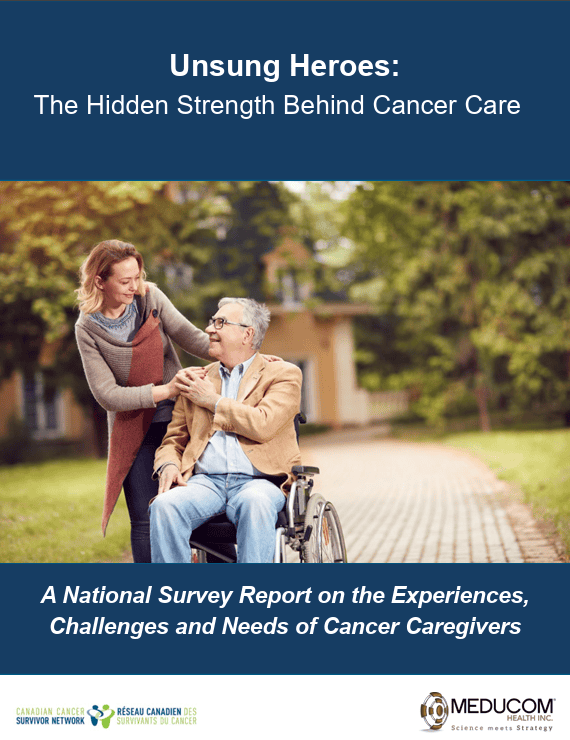
 Ottawa, ON – The Canadian Cancer Survivor Network (CCSN) is pleased to release our report “Unsung Heroes: The Hidden Strength Behind Cancer Care”. CCSN commissioned Leger to conduct the survey, and the report, written by Meducom Health Inc., highlights the experiences, challenges and needs of cancer caregivers in Canada.
This essential part of cancer care takes great commitment; our survey found that caregivers dedicate an average of 21 hours per week to their responsibilities. In addition to this commitment, many caregivers report emotional and physical exhaustion, and financial strain. Nine in 10 caregivers reported experiencing challenges with caregiving, and two in five caregivers have had to either reduce their work hours or stop working entirely as a result of caregiving.
Caregivers in Need of Support
Caregivers utilized many support services, the most common being emotional support, practical support, and respite care. While they varied greatly about why they needed support, only a third found that support services were easily accessible. While government programs were available and some caregivers applied to those, no single program stood out as particularly effective.
Caregivers themselves recommended that those caregiving should advocate for themselves and ask about support services. Our survey found that only 32 per cent found help through healthcare practitioners, while most found them through their own internet searches.
CCSN calls on governments at all levels to expand support for cancer caregivers, to strengthen and promote existing programs, and to work to lessen the burden of caregiving on these essential but often overlooked unsung heroes of cancer care.
Quick Facts
- Nine in 10 caregivers have experienced challenges with caregiving, which most often include emotional stress and lack of time.
- Among those who have experienced challenges, three-quarters have taken action to overcome these challenges, including taking time for self-care or seeking support from family and friends.
- Two of five caregivers have either reduced work hours, started a new job, or fully stopped working as a result of caregiving.
- 51 per cent of caregivers noted a negative impact on their mental health.
- Over half of caregivers reported using caregiver support services.
- 69 per cent of caregivers had additional support to care for their loved ones.
Quotes
“In our survey, over 70 per cent of caregivers reported that the emotional stress of caregiving was a major challenge. Watching [my wife’s] condition worsen over time was emotionally overwhelming, as was the knowledge that I could do nothing to make her better, no matter how desperately I wanted to. My role as a caregiver was to make her as comfortable as possible while she was dying. We talk about cancer patients who survive developing a new normal; this is also true of cancer caregivers. Life is never the same, and for those whose loved ones die, everything changes.” – Jackie Manthorne, CCSN President & CEO and caregiver for her late wife.
“Our ultimate goal for these findings is to collaborate with existing caregiver organizations to improve support for all caregivers. We believe this to be true due to the types of challenges highlighted in the report by cancer caregivers that these challenges are translational to all caregivers.” – Lindsay Timm, CCSN Executive Director