




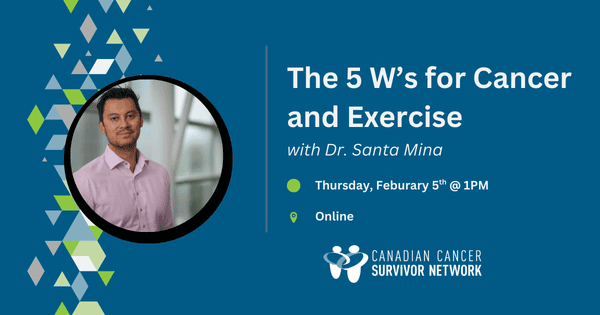
About this Webinar: This session discusses the who, what, when, why, and how of exercise for people living with and beyond cancer. This talk breaks down the science into clear, actionable insights—helping you understand who can benefit from exercise, what types of activity are safe and effective, when to get started, why exercise matters for treatment and recovery, and how to make it part of your routine.
About this Presenter: Dr. Daniel Santa Mina is a kinesiologist and exercise physiologist. He is a Professor at the University of Toronto in the Faculty of Kinesiology and Physical Education and Clinician Investigator at the University Health Network in Toronto, Canada. At UHN, he also is the Director of Research and Programming for the Prehabilitation Program, and Research Lead for the Goodhope Exercise and Rehabilitation Program. Dr. Santa Mina’s research focus is exercise, rehabilitation, and prehabilitation in cancer and other clinical populations. He is also the Founder of PrehabRx – a free exercise oncology and surgical prehabilitation service.
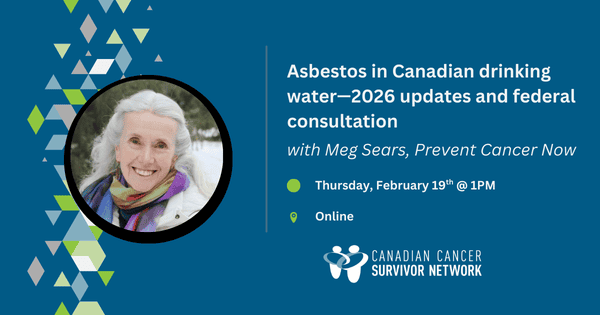
About this webinar: Is it safe to drink asbestos-contaminated water? Join Prevent Cancer Now Chair Meg Sears for an update on cancer risks from ingesting asbestos, as Health Canada seeks feedback on its 2026 assessment. Asbestos is a known human carcinogen, and airborne asbestos has been regulated and banned accordingly. In contrast, Health Canada provides no guidance regarding asbestos in drinking water, despite approximately 14,000 km of deteriorating asbestos cement pipes delivering drinking water to Canadians. A new draft assessment of water-borne asbestos reiterates that “there is no consistent, convincing evidence” that drinking asbestos is harmful. What is the evidence? What does this stance mean for public health? How should local governments address crumbling water pipes that are contaminating water?
About the presenter: Meg Sears (PhD) has advanced environmental health for decades, and as Chair of Prevent Cancer Now she works to “make least-toxic the norm.” She was trained in Chemical Engineering and Applied Chemistry (University of Toronto) and biochemical engineering (PhD, McGill), and has diverse laboratory experience including energy research. With skills in scientific analysis and writing, she later gained associations with medical researchers. Some highlights include: the “Medical Perspective on Environmental Sensitivities” for the Canadian Human Rights Commission, leading to a policy under the Canadian Human Rights Act; a CIHR and SSHRC funded review of environmental, public health and medical approaches for toxic elements; three guidance documents addressing toxicants (man-made chemical substances), indoor environments, and COVID-19 with the Canadian Committee on Indoor Air Quality; and rich collaborations with Canadian environmental health and policy organizations. When she is not working, you’ll probably find Meg roaming the outdoors, or “playing in the mud,” and gardening.
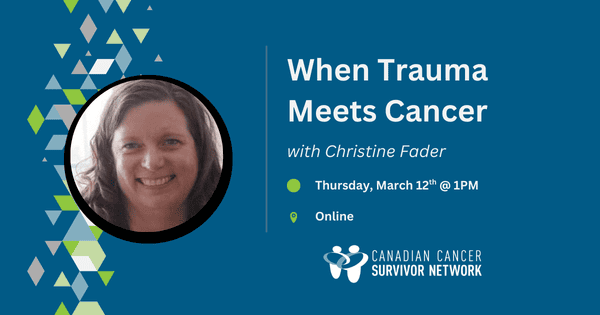
About this Webinar: Content warning – this session will include mention of difficult topics including child abuse (sexual and physical), foster care, residential schools, and homelessness.
What happens when patients with trauma face a cancer diagnosis? Christine Fader’s husband refused treatment for a very curable cancer. Like him, 34 per cent of Canadian adults report being survivors of childhood sexual or physical abuse. Research indicates that patients with childhood or other trauma histories tend to experience cancer diagnoses at an increased rate, refuse or leave treatment more often, and die sooner and more frequently. Even patients who had no previous trauma prior to cancer can be impacted by the very treatments and processes designed to help them. Yet, trauma-informed care is still not wide-spread in our cancer and healthcare systems.
Drawing on her lived experience of supporting her husband through two primary (unrelated) cancers, as well as 20+ years as a career advisor/instructor at Queen’s University and in the School of Medicine, Christine will share insights and ideas to help cancer patients, loved ones, and care partners navigating the cancer system.
About the presenter: Christine Fader volunteers as a patient and family advisor with Ontario Health/Cancer Care Ontario, the Southeastern Ontario Cancer Program, and the Lung Health Foundation. She is an author and has written for many publications, including an article about trauma in cancer, published by the Canadian Medical Association Journal (CMAJ) in October 2025. Learn more at: christinefader.com
About this Webinar: Lymphedema is a common but often underrated side effect of cancer treatment. This session will explain what lymphedema is, why it can occur after cancer, and the key risk factors to be aware of. Participants will also learn about current treatment approaches and how nutrition and lifestyle may support lymphatic health. Join registered dietitian and cancer survivor Jean LaMantia for an accessible, evidence-informed overview designed to help cancer survivors better understand and manage their risk.
About the presenter: Jean LaMantia is a registered dietitian, cancer survivor, and author of four books on the topics of lymphedema, cancer, and intermittent fasting. She is also the creator of daily and weekly journals designed to help individuals with lymphedema and lipedema track their diet and self-care practices and better understand how these factors influence their health.
Jean is the creator and facilitator of Lymphedema Nutrition School, an online program that supports people living with lymphedema. She also teaches a continuing education course for dietitians and lymphedema therapists focused on advancing education and advocacy for the nutritional management of lymphedema.
She has presented at national and international conferences and is a strong advocate for a multidisciplinary approach to lymphedema management. Jean is the recipient of the Distinguished Practice Award from the Oncology Dietetics Dietetic Practice Group of the Academy of Nutrition and Dietetics.
Jean lives in Toronto, where she runs a virtual private practice providing one-to-one nutrition counselling. Learn more about Jean or schedule a free consultation at www.jeanlamantia.com
About this Webinar: Navigating cancer treatment decisions, whether for a new diagnosis or recurrent disease, can feel overwhelming. This workshop session offers practical guidance to help individuals and families approach these choices with clarity and confidence. Participants will learn how to prepare for cancer treatment decision making appointments, identify key questions to ask, and engage in meaningful conversations with their care teams.
This session explores:
– Learning how to recognize your treatment needs and how to respond
– How to be more knowledgeable about your diagnosis and treatment options
– Building your support system
– How to ask the right questions and advocate for what you need
– Information for caregivers and making treatment decisions
– Making choices that are right for you
Audience: Adults living with cancer, adult caregivers for people living with cancer, support professionals seeking tools for compassionate, informed [shared] decision-making during cancer care.
About the presenter: Lisa Malinowski Kamran, MSW, RSW (she/her) is a Registered Social Worker , Yoga Teacher (E-RYT 200), and Mindfulness Educator. Her grounded and compassionate energy fosters welcoming and inclusive spaces for individuals to be seen and heard.
With a diverse professional background, Lisa leverages her Bachelor’s in Hospitality Business, Master’s in Social Work, and a decade of contemplative practice studies to attune to individuals’ unique needs. Her work has offered her the opportunity to be part of equitable health initiatives and to provide mindfulness and mental health support across Canada and the United States. Now based in Toronto, Lisa serves as the Membership and Outreach Coordinator at Gilda’s Toronto, supporting individuals and families impacted by cancer.
View the Video: HERE
View the Slides: HERE
About this Webinar: The vagus nerve is the main path of your nervous system, connecting your brain to your heart and digestive system. Stimulating the nerve can have several health benefits for those experiencing cancer and into survivorship. Join the team from CancerPEP to learn practical techniques to settle down stress, feel better and prime the body’s healing capacity.
About these Presenters: Dr. Rob Rutledge is a Radiation Oncologist in Halifax, Nova Scotia, specializing in breast, prostate and pediatric cancers, and is an Associate Professor in the Faculty of Medicine at Dalhousie University. His passion is empowering people affected by cancer, and has delivered hundreds of public talks and webinars, along with over 60 retreats and day-long seminars to thousands of cancer survivors. Rob has received a Cancer Care Nova Scotia Award for Excellence in Patient Care, and Doctors Nova Scotia presented him with a Health Promotion Award in recognition of his contribution to physician health and health promotion in cancer patients.
Dr. Gabriela Ilie is a Dalhousie Faculty of Medicine Endowed Scientist in Prostate Cancer Quality of Life and an Associate Professor in the Departments of Community Health and Epidemiology, Urology, Radiation Oncology and Psychology, and Neuroscience at Dalhousie University. She is an Affiliated Scientist with Nova Scotia Health Authority, Queen Elizabeth II Health Sciences Center, and Scientist with the Beatrice Cancer Research Institute. Gabriela initiated and leads the PC-PEP, CancerPEP and now Pictou County PEP Programs and the scientific and clinical teams behind these programs. Dr. Ilie has an established track record of publications with 99 papers (H index 25, i10 index 45; 4900+ lifetime citations). Her work has appeared in highly ranked journals such as European Urology, JAMA, American Journal of Men’s Health, BMJ Open, Psycho-oncology, and others. Dr. Ilie presents her work regularly at national and world congresses and has given over 300 public talks.
Dr. Ilie and Dr. Rutledge co-lead CancerPEP, a research-proven, six-month, daily home-based Patient Empowerment Program. This wellness program helps patients take control of their physical and mental health and build resilience by daily participation that incorporates fitness, nutrition, mindset, relationships and more. Visit CancerPEP.org to learn more, or, if you are a prostate cancer patient, visit PCPEP.org
Watch the Video: HERE
View the Slides: HERE
About this webinar: This webinar will highlight the Colorectal Cancer Resource & Action Network’s (CCRAN’s) national costs and benefits analysis of comprehensive genomic profiling (CGP), conducted in partnership with Signal49 Research (formerly The Conference Board of Canada), demonstrating the transformative clinical and economic value of precision testing in metastatic cancer care.
These findings demonstrate that universal CGP across five high-mortality cancers (lung, colorectal, pancreatic, breast, and prostate) could generate significant healthcare savings ($87–$134 million), and result in a gain of 3,440 life-years for patients (in the identified cancer types), and produce substantial societal benefits—all while keeping diagnostic costs low. Building on this strong foundation, CCRAN’s next phase of research will shift from economic modelling to real-world evidence.
Cassandra will share insights into upcoming research which will examine patient pathways and timing of testing, evaluate how genomic profiling influences treatment decision-making across tumour types, and identify system-level inefficiencies and bottlenecks impacting access, funding, and implementation. This work aims to bridge the gap between economic modelling and implementation, supporting actionable policy change to enable equitable, nationwide access to CGP in Canada.
About the Presenter: Cassandra Macaulay, BSc, MHS, RTNM, is the Chief Research Officer at the Colorectal Cancer Resource & Action Network (CCRAN). She leads CCRAN’s policy- and research-based initiatives and contributes broadly across the organization’s patient-focused and evidence-based mandates to provide support, education, and advocacy for colorectal cancer and other tumour-type patients and caregivers.
Cassandra has a clinical background as a Medical Radiation Technologist in addition to a graduate degree in health studies and leadership. It was through her experience as a clinician, observing the unmet needs of patients and the gaps in the healthcare system, that she turned to patient advocacy, driven by a passion for improving health quality and patient experiences. Through her role at CCRAN, she is honoured to amplify patient voices and is dedicated to reducing the burden of cancer in Canada.
View the Video: HERE.
View the slides: HERE.
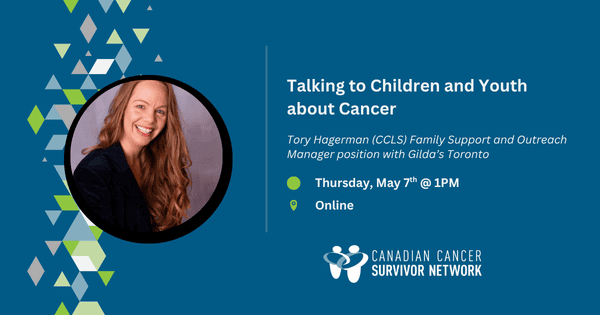
About this Webinar: This session is intended for parents and guardians living with a cancer diagnosis, as well as professionals and community members who desire to communicate openly and compassionately with children about cancer. Together, we’ll explore how to support young people through honest, age-appropriate conversations that acknowledge the emotional weight of illness.
Topics include:
- How children at different developmental stages understand illness and cancer
- The importance of honest, developmentally appropriate communication
- Simple ways to offer emotional support—even when we don’t know exactly what to say
- How validating big feelings fosters emotional intelligence and resilience
- How Gilda’s Toronto supports families through education, connection, and community
Grounded in evidence-based practices in child development, grief theory, and family-centered care, this interactive session offers reflection, practical tools, and shared resources. The goal is for each individual to leave feeling more equipped and empowered with tools, to have open, honest and supportive communication with their children around the difficult topic of cancer.
About the presenter: Tory Hagerman (she/her) holds the Family Support and Outreach Manager position with Gilda’s Toronto and is a Certified Child Life Specialist (CCLS). Over the past 16 years, Tory has worked with a diverse group of children, youth, and families in clinical, community, and home settings. As a Certified Child Life Specialist, Tory is passionate about providing family-centered care while supporting the health equity and psychosocial needs of children, youth & families, through life-changing events. Tory has extensive experience engaging children in play-based psychosocial education and emphasizes inclusion and accessibility in her work. Tory is highly motivated in her work, dedicated to empowering families and ensuring that every child has a safe and trusted person they can turn to when facing life’s difficult challenges.
View the Video: HERE.
View the Slides: HERE.
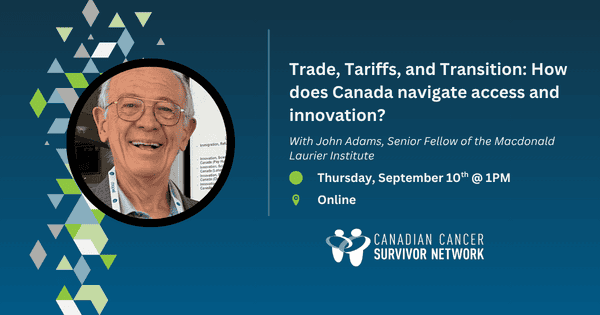
About this webinar: Need a level-set on where things stand and seem to be heading after the blizzard of headlines in mainstream and social media?
Canada & India are the only two developed countries which have not signed deals under the Most Favored Nation (MFN) policy for drug prices of President Trump. How exposed are we? What can and should we do?
About the Presenter: John is a survivor of a rare cancer and coronary event. He is a seasoned management consultant, passionate patient advocate and senior fellow of the Macdonald Laurier Institute, an Ottawa-based think tank, where he focuses on health issues. His past work includes being a newspaper reporter, chief of staff to an Ontario Cabinet Minister, and was elected to Toronto City Council three times.
In 2008, he co-founded the Canadian PKU and Allied Disorders non-profit. He has an adult son with PKU, a rare genetic brain-threatening disorder, who benefited greatly from newborn screening, early intervention, lifelong therapy and an innovative, miracle drug. That son is a university graduate and urban firefighter.
John is a member of two advisory committees of Health Canada: the implementation advisory group for the Strategy for Drugs for Rare Disorders for which he is the patient co-Chair for 2026-2027; and the multi-stakeholder steering committee on Drug Supply Chain & Shortages.
He has volunteered as a board member of the Best Medicines Coalition and is a former board chair of the Canadian Organization of Rare Disorders.
John is the father of four, grandfather to one, and was primary caregiver to his wife who died of amyotrophic lateral sclerosis and frontotemporal dementia. He lives in Toronto and on Vancouver Island with his new partner Teresa Sande, a retired medical doctor. They enjoy winters and more in a home overlooking the largest lake in Mexico.