






On April 2, 2025, the Canadian Cancer Survivor Network (CCSN) hosted its second All-party Cancer Caucus (APCC) in Victoria, British Columbia. The caucus meeting was facilitated by CCSN staff members Lindsay Timm, Community Engagement Manager, and Stacey Ludlow, Social Media & Events Coordinator.
Timm also introduced those who would be speaking during the meeting: Dr. Dustin Pearson of Evict Radon National Study & Research and the Goodarzi Lab of the University of Calgary; Laura Floyd, a lung cancer patient and advocate; and Cassandra Macaulay of the Colorectal Cancer Resource & Action Network (CCRAN).
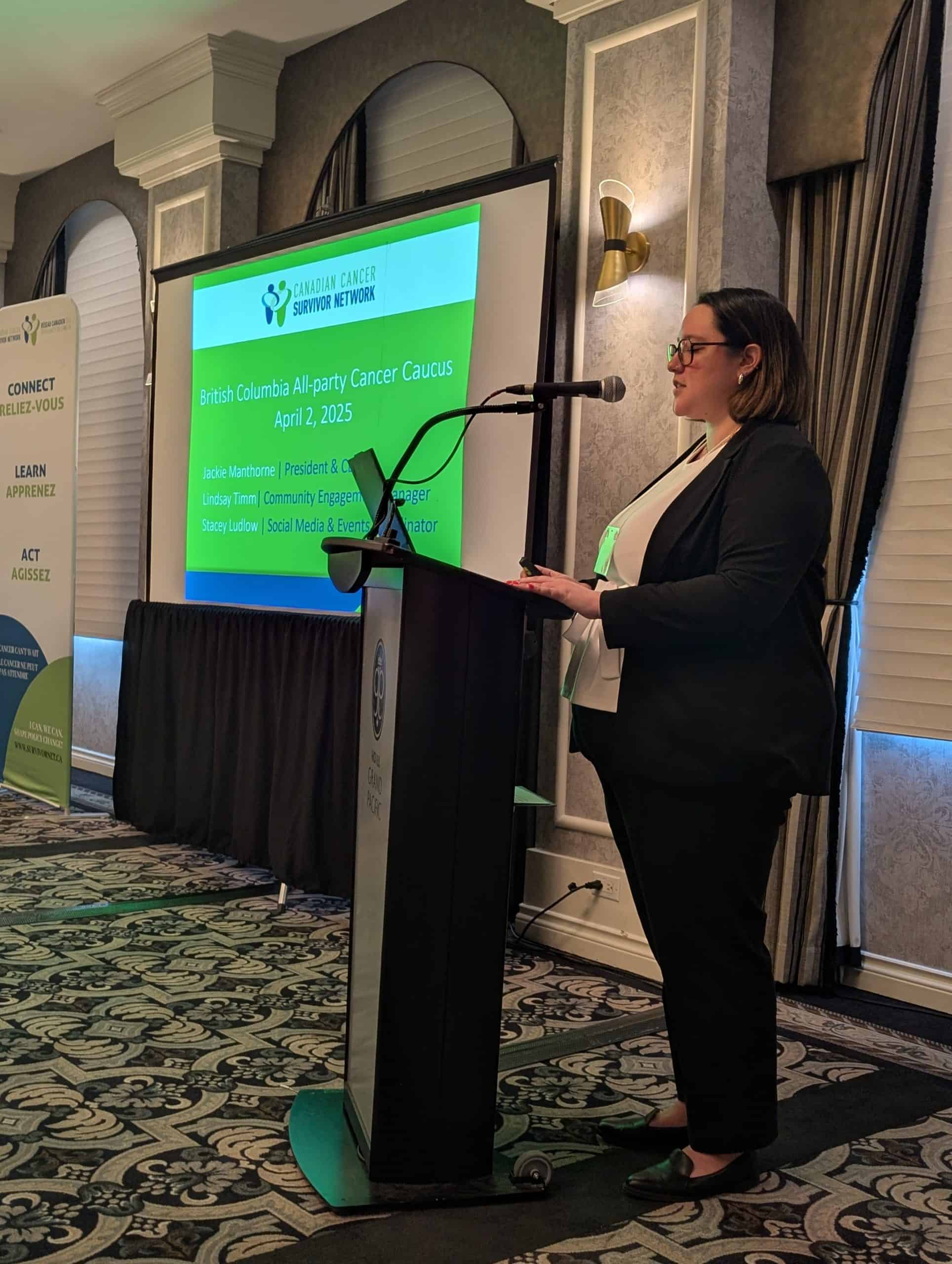 Timm opened the session by acknowledging that the meeting was taking place on the traditional territories of the Lekwungen Peoples, the Songhees and Esquimalt Nations. As this was a newly elected government, Timm outlined several of CCSN’s activities, such as our flagship webinar and podcast series, Science of Cancer course, Right2Survive lung cancer coalition, published reports on COVID-19 disruption of cancer care, All-party Cancer Caucuses in other provinces, and legislative receptions.
Timm spoke to the caucus members about the cancer risks that firefighters face. “With the upcoming wildfire season, we wanted to remind you how important it is to ensure that all firefighters are protected using the best possible equipment, such as properly sealed and fitted bunker gear.” She also spoke about the presentation that CCSN made at the Ontario APCC in the fall of 2023, where we stressed the importance of covering wildland firefighters under worker’s compensation legislation. Since then, this coverage has been added in Ontario. “CCSN is proud to be a part of the work that has been done over the past year by many organizations to improve the protection, care, and health of these unsung heroes.”
Timm reminded the MLAs who were present, that during the previous APCC, Dense Breasts Canada and Colorectal Cancer Resource & Action Network, had discussed the need for British Columbia to add more supplemental screening for breast cancer and lower the age for colorectal cancer screening.
British Columbia does offer supplemental screening for breast cancer, but only 11 clinics across the province have made it accessible. Timm said that this was not sufficient to meet the needs of women needing supplemental screening because of heightened breast density.
Colorectal cancer screening isn’t much better: “Colorectal cancer rates have nearly doubled in younger adults under 50 since the early 1990s while decreasing in older adults. There is innovative work being done to treat this rise in diagnosis in young adults right here in British Columbia by Dr. Jonathan Loreen and his colleagues. His study shows that there are distinct subgroups within the 18 to 50 age group that exhibit different clinical and genetic features. This information helps clinicians create more effective precise treatment plans. These are amazing findings, but the work to diagnose early has remained stagnant.”
CCSN also completed a variety of projects. First, the new Canadian Prostate Cancer Guide which is an aggregate website that pulls together all the best resources in one place for patients, caregivers, and survivors to explore the information that they need.
Second, our podcast series was launched on Spotify at the beginning of 2025 with topics that follow emerging cancer issues.
Finally, this caucus is the first to hear about CCSN’s latest project: a newly commissioned Leger survey to gather insights from cancer caregivers to identify the experiences, challenges, and support needs of cancer caregivers in Canada. The results will help CCSN identify gaps where there is greater need for resources and support.
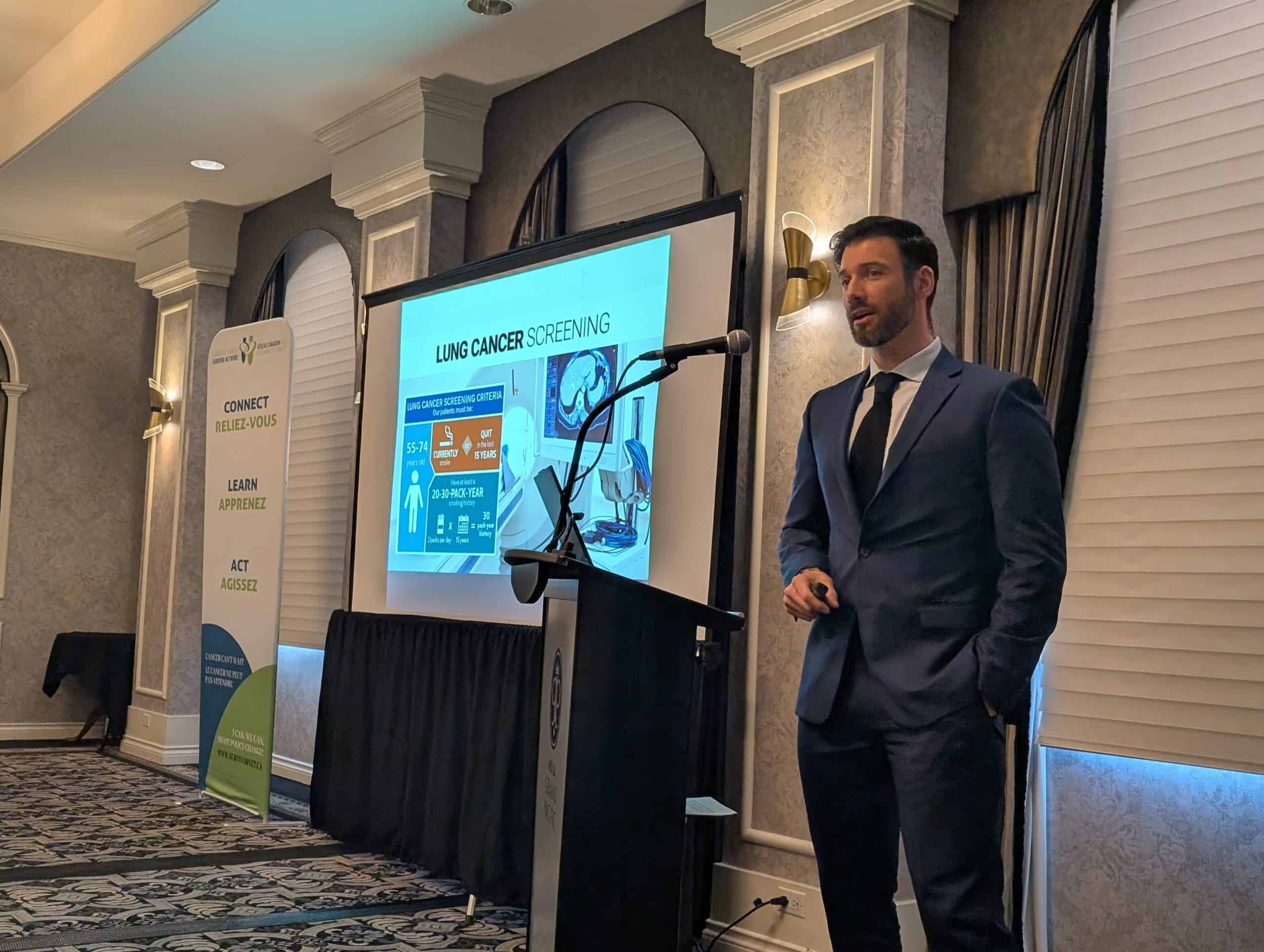 Dr. Dustin Pearson: “We need to change the narrative of lung cancer screening to improve prevention for non-smokers.”
Timm introduced Dr. Dustin Pearson, Scientific Operations Manager of the Evict Radon National Study and Research Operations Lead at the Goodarzi Lab at the University of Calgary, who presented on radon exposure in Canada. Dr. Pearson detailed the progress he and his fellow researchers at the Environmental Cancer Research Hub have made studying radon across Canada. Radon is the leading cause of lung cancer for people who do not use tobacco.
“Canada has amongst the highest lung cancer incidence and mortality in the world. What is even more important to note is that the stage of diagnosis for those over 50, which is essentially 50 per cent of all lung cancers, is stage four. The five-year survival rate for these patients diagnosed at stage four is three per cent. If we can shift diagnosis to stage one, statistics improve from three per cent to 80 to 90 per cent.
“Approximately 40 per cent of lung cancer cases are not due to tobacco. This means that we are exposed to other lung cancer risk factors during our lives. What we are studying at the Environmental Cancer Research Hub is air pollution, asbestos, arsenic, and the most prominent source of lung cancer, which is radon gas.”
Dr. Pearson brought to the attention of the MLAs present that the current lung cancer screening program in British Columbia has narrow criteria in both age and smoking. He said by limiting the program to those between 55 and 74, with a stipulation the patient must have smoked for 20+ years, their lung cancer screening program excludes 40 per cent of those who could still get lung cancer. Most of these are non-smokers due to radon and other environmental risk factors.
After explaining how radon is created in the earth and how it causes lung cancer, he described how scientists measure it. Dr. Pearson described this process with CCSN in his November 2025 webinar. To view that webinar, click HERE.
Dr. Pearson explained that radon is a naturally occurring radioactive gas that comes from the ground. On an average day, radon is coming out of the ground at a regular rate, but the wind takes it away and whittles it down to nothing. The issue is our homes have ground contact that captures and traps radon gas, some at high levels, that can cause lung cancer. One in five homes in Canada have a level that is above Health Canada’s limit on what is safe.
“There is a solution for this,” Dr. Pearson stated. Testing kits for radon are available for approximately $200.00. If a test shows high levels, then the installation of a Radon Mitigation System can be installed. This is a five-inch hole inserted at the lowest level of your foundation, with pipes and a fan on top, that to blow the gas out. Research has shown that after mitigation, homes that have high levels drop to very low levels.
“We are hoping that the next federal building codes will stipulate that a full passive mitigation system, which is a tube going from your foundation floor to your roof, must be installed in new builds. This has been shown to decrease radon exposure by up to 40 per cent to 50 per cent.
“Ultimately, the most important call to action is that we need to change the narrative about lung cancer screening to improve prevention for non-smokers. We are conducting a large clinical trial that can show the amount of radon you’ve been exposed to across your lifetime by examining toenails! Radon converts into lead in your body and gets absorbed by your tissues. Toenails are one of the ways the body expels this lead. Examining clippings will provide a correlation between the lead in toenails to radon exposure, which would then allow you access to a lung cancer screening program.”
Laura Floyd: “I’m going to talk about what didn’t happen to me rather than what did.”
Dr. Pearson introduced Laura Floyd. At age 39, Laura Floyd was partway through articling at a pro bono law firm, on her way to fulfilling a dream she had held since she was a teenager, when a diagnosis of stage three lung cancer changed everything.
After months of chemotherapy, radiation, and surgery left her unable to return to work, Floyd channeled her experience into advocacy. She became involved with organizations like Lung Cancer Canada, the International Association for the Study of Lung Cancer, and the Canadian Cancer Survivor Network, working to help raise awareness about lung cancer, expand research, and advocate for better patient support and outcomes. She has also been a co-researcher on two projects with the Anew Research Collaborative, focusing on the unique experiences of young adults with cancer.
In addition to her advocacy efforts, Floyd also uses humour as a tool for awareness by performing stand-up comedy that addresses the realities of living with lung cancer to break down stigmas and stimulate discussions.
Born and raised in Greater Victoria, Floyd studied communications in Ottawa and worked on Parliament Hill for several years. She later returned home to join the public service, start a family, and eventually, study law at the University of Victoria. She lives in Victoria with her husband and daughter.
“Every survivor’s story is made up of two parts. One part is the stuff that happened to us. The stuff that we survived. And the other, maybe more important, is the stuff that didn’t happen to us, the reason that we survived.
“The most important thing that didn’t happen to me, the most important reason that I am here today is that my symptoms were not discounted. I was taken seriously the very first time that I contacted the healthcare system, and the reason for that is a complete and total fluke. I had an elevated heart rate, high blood pressure, and was generally not feeling well, so I went to the ER. Many lung cancer patients my age get to that point. But when they see an ER doctor, they are told that it’s anxiety, like my friend Elle was told. Or they are told that it’s depression, like my friend Cheryl. Or asthma, like Aaliyah was told. Or that you need to lose weight, like my friend Shannon was told. But I was sent for an x-ray and none of my friends were. And I’m still here, and they’re not. All because I was sent for one more test.”
Floyd had no known risk factors, including age, tobacco use, radon exposure, or family history. She had non-specific symptoms, which are common because symptoms like a cough or pain often don’t appear until lung cancer has spread. There was no diagnostic delay – her cancer was found the first time she went in looking for answers, whereas most patients, especially younger ones, must make repeated attempts to get a diagnosis.
“I want to say that she was an exceptional doctor or there was something special about it, but honestly, I think the reason is she was kind of bored because I happened to hit the ER on a quiet night. And I know that there’s a saying that hard cases make bad law and certainly trying to make sure that every ER always has a quiet night is not good healthcare policy. But hard cases make good examples of procedures we can improve.
“That’s why I hope you will listen to the scientists and the experts, like our previous speaker from Evict Radon, and the speaker who is about to come up, who is going to point out the places where we can improve, so that stories like mine become unusual. Not because it was found at stage three, but because it wasn’t found at stage one. I hope you will carry that story with you when you are making these decisions.”
Cassandra Macaulay: “I think we can all agree that British Columbians deserve better.”
Cassandra Macaulay, Chief Research Officer at the Colorectal Cancer Resource & Action Network (CCRAN) spoke next. She shared what biomarker testing for stage four or metastatic cancer patients currently looks like in British Columbia.
“A little over a year ago, I had the privilege of being here and speaking to you about colorectal cancer screening. Today, I am very grateful and honoured to represent not only CCRAN and CCSN, but multiple patient groups with whom we have partnered to raise awareness and elicit change in biomarker testing, and ultimately to make a profound difference in the lives of metastatic cancer patients.”
Macaulay shared that CCRAN is a national, patient-focused organization that champions the health and well-being of Canadians touched by colorectal cancer and others at risk of developing the disease. They provide support, education, and advocacy to colorectal cancer patients and their caregivers to help improve both quality of life and longevity. CCRAN’s overarching mission is to reduce the burden of cancer in Canada. And as such, they have expanded their future-focused mandate across tumor types.
Macaulay began by clarifying what biomarkers are and how they impact cancer patient care. “Biomarkers can be many things, but when talking about cancer care, it’s the genetic mutation or the alteration driving a person’s cancer. Biomarkers can be compared to a genetic fingerprint of an individual’s cancer. Biomarker testing allows us to identify these mutations or read the fingerprint. This really sits at the center of personalized medicine, as it provides the information that is needed to make individualized treatment decisions for cancer patients. Biomarker testing allows us to harness the potential of precision medicine and adds value to our healthcare system by improving both quality of life and longevity for cancer patients.
“But biomarker testing is often not done efficiently or comprehensively, and relevant biomarkers can be missed. Enter comprehensive genomic profiling, or CGP. CGP is a test that assesses hundreds of biomarkers to detect abnormalities or mutations in the tumour. Analyzing the tumour can inform diagnosis, prognosis and treatment selection, and it can help to identify eligibility for clinical trials as well.
“Comprehensive testing, though it does require initial investment or reallocation of funds, drives value within our healthcare system and with our society at large.”
Macaulay gave the specific example of colorectal cancer, British Columbia’s second leading cause of cancer. “The expectation is that biomarker testing results are available at the time of the first appointment between the patient and their oncologist. The unfortunate reality in British Columbia, is that this is happening only 11 percent of the time. Half of BC respondents, from a pan-tumour patient survey, have waited more than two months to receive their results. This means that most metastatic cancer patients in this province are in the unenviable position of having to start toxic chemotherapy without knowing what the best drug to treat their cancer.”
In 2023, CCRAN held a virtual biomarkers conference, where over 60 experts came together. There were many recommendations to address timely access to biomarker testing results to reduce the burden of cancer, but these two are critical:
- Maximize use of automation and AI within pathology laboratories to improve efficiencies in testing and minimize the number of steps that a sample must go through before the results are communicated to patients.
- Implement reflexive biomarker testing protocols. This essentially is a protocol to permit additional testing to be completed within a predefined set of criteria without having to wait for the intervention of an ordering physician.
“While there is much work to be done, these two calls to action will assist in making progress towards the ultimate goal of having the results ready by the time of the patient’s first appointment. CCRAN held another biomarkers conference in 2024 where we partnered with 24 patient groups. At the 2024 event, the calls to action from experts focused on improving access to publicly funded CGP for all patients with metastatic cancer as well as developing national standards. CCRAN’s biomarker efforts have generated significant engagement, and I think this really speaks to the importance of this topic, not only in the cancer care community, but also across research, policy, and among the public.”
“We know that there is a missing piece to the puzzle, and with respect to CGP, the missing link is the economic piece to support the implementation of CGP into the cancer care landscape. So, CCRAN has partnered with the Conference Board of Canada to model and analyze the cost benefits of the implementation of CGP as a standard of care. We are doing this across the top five cancers, and then we are going to extrapolate the data across other cancer types.”
Macaulay extended an invitation to the individuals present to attend the CCRAN virtual Biomarkers Conference in June, where the results of this comprehensive genetic testing cost-benefit analysis will be presented with the hope that it will inform public policy.
The meeting finished with a very interactive question period. CCSN’s goal for this, and every All-party Cancer Caucus, is to ensure that our political leaders understand not only the needs and challenges of the cancer community but also the power that they uniquely hold to make the hope of becoming a cancer survivor a reality. We look forward to coming together again in British Columbia, where we can collaborate and discuss the best ideas for cancer care and healthcare in this province.
Attendees
CCSN
Lindsay Timm, Community Engagement Manager, Canadian Cancer Survivor Network
Stacey Ludlow, Social Media & Events Coordinator, Canadian Cancer Survivor Network
Evict Radon
Dr. Dustin Pearson, Scientific Operations Manager, Evict Radon National Study & Research, Operations Lead, Goodarzi Lab, University of Calgary
Lung Cancer Patient Advocate
Laura Floyd
Colorectal Cancer Resource & Action Network
Cassandra Macaulay, Chief Research Officer
MLA Members of the All-party Cancer Caucus
NDP
Hon. Minister Jagrup Brar – Surrey-Fleetwood – Minister of Mining and Critical Minerals
Hon. Minister Rick Glumac – Port Moody-Burquitlam – Minister of State for Artificial Intelligence and New Technologies
Hon. Minister Ravi Parmar – Langford-Highlands – Minister of Forests
Hon. Minister Jennifer Whiteside – New Westminster – Minister of Mental Health and Addictions
Hon. Minister George Chow – Vancouver-Fraserview – Minister of Citizens Services
Hon. Minister Jodie Wickens – Coquitlam-Burke Mountain – Minister of Children and Family Development
Jennifer Blatherwick – Coquitlam-Maillardville
Susie Chant – North Vancouver-Seymour
Sunita Dhir – Vancouver-Langara – Parliamentary Secretary for International Credentials
Hon. Minister Nina Krieger – Victoria-Swan Lake – Minister of Public Safety and Solicitor General
Joan Phillip – Vancouver-Strathcona – Parliamentary Secretary for Community Development and Non-profits
Janet Routledge – Burnaby North – Government Whip
Harwinder Sandhu – Vernon-Lumby – Parliamentary Secretary for Agriculture
Anna Kindy – North Island
Conservative
Sharon Hartwell – Bulkley Valley-Stikine
Kristina Loewen – Kelowna Centre
Korky Neufeld – Abbotsford West
Lorne Doerkson – Cariboo—Chilcotin
David Williams – Salmon Arm-Shuswap
Lynne Block – West Vancouver-Capilano